
In music theory and acoustics, the relationship between frequency and musical notes is fundamental: each note corresponds to a specific frequency (or range of frequencies), and the pitch of a note is directly determined by its frequency.
Here’s how it works:
1. Frequency and Pitch
- Frequency (measured in Hertz, Hz) is the number of vibrations per second of a sound wave.
-
Pitch is the perceived highness or lowness of a sound, which is directly tied to its frequency:
- Higher frequency = Higher pitch (e.g., a whistle or piccolo).
- Lower frequency = Lower pitch (e.g., a bass guitar or tuba).
2. Standard Tuning: A4 = 440 Hz
- The modern standard tuning for music is based on A4 (the A above middle C) vibrating at 440 Hz.
- This is the reference point for tuning instruments worldwide.
3. The Musical Scale and Frequencies
Musical notes are organized into scales (e.g., C major, A minor), and each note in the scale has a specific frequency ratio relative to the others. The most common system is the 12-tone equal temperament (12-TET), where:
- An octave (e.g., C4 to C5) is divided into 12 equal steps (semitones).
- Each semitone has a frequency ratio of 2^(1/12) ≈ 1.05946 (about 5.946% higher than the previous note).
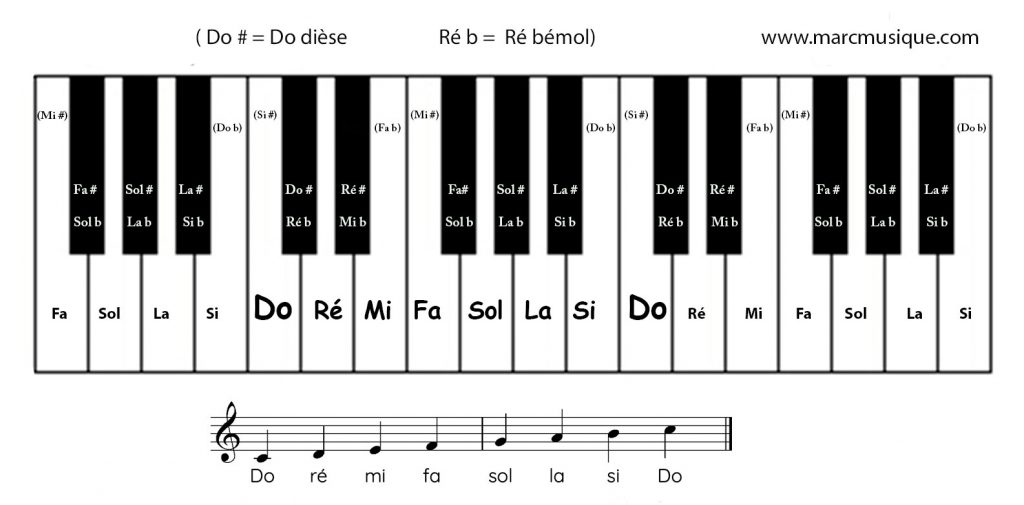
Example Frequencies for the C Major Scale (Starting at C4 = 261.63 Hz)
| Note | Frequency (Hz) | Ratio from C4 |
|---|---|---|
| C4 | 261.63 | 1.0000 |
| D4 | 293.66 | 1.1225 (2^(2/12)) |
| E4 | 329.63 | 1.2599 (2^(4/12)) |
| F4 | 349.23 | 1.3348 (2^(5/12)) |
| G4 | 392.00 | 1.4983 (2^(7/12)) |
| A4 | 440.00 | 1.6818 (2^(9/12)) |
| B4 | 493.88 | 1.8877 (2^(11/12)) |
| C5 | 523.25 | 2.0000 (2^(12/12)) |
4. Octaves and Frequency Doubling
- Notes one octave apart have frequencies that are double or half of each other.
- Example: A4 = 440 Hz, so A5 = 880 Hz (double), and A3 = 220 Hz (half).
- This is why notes an octave apart sound "the same" but higher or lower.
5. Harmonics and Overtones
- Most musical sounds are not pure sine waves but complex waves made of a fundamental frequency (the pitch you hear) and overtones (higher frequencies that add timbre/color).
- Example: A violin and a piano playing the same note (e.g., A4 = 440 Hz) will sound different because their overtone structures differ.
6. Practical Implications
- Tuning instruments: Musicians use tuners to match the frequency of their instrument to the correct pitch (e.g., A4 = 440 Hz).
- Transposition: Changing the pitch of a piece (e.g., from C major to D major) requires adjusting all frequencies by the same ratio.
- Electronic music: Synthesizers generate notes by producing waves at specific frequencies.
7. Non-Equal Temperament Tunings
While 12-TET is standard, other tuning systems exist:
- Just Intonation: Uses simple whole-number ratios (e.g., 3:2 for a perfect fifth) for purer-sounding intervals.
- Pythagorean Tuning: Based on stacking perfect fifths (ratio 3:2).
- Meantone Temperament: Common in Baroque music, with sweeter-sounding thirds but "out-of-tune" remote keys.