

Prologue: Cairo, 1929
The boy was nine years old when the riots came. Yasser—then just Mohammed Abdel Rahman Abdel Raouf Arafat al-Qudwa—stood in the alleyways of Cairo’s Jewish Quarter, watching as men with knives and clubs screamed "Death to the Jews!" His father, a textile merchant, had sent him away from Jerusalem, fearing the violence. But violence had followed. That night, as the smoke from burning synagogues curled into the sky, the boy made a promise: One day, Palestine would be free. He didn’t know how. He didn’t know when. But he knew he would never forget.
Part I: The Making of a Revolutionary (1948–1967)
Chapter 1: The Nakba
1948. Jaffa. Yasser, now 19, smuggled weapons into Palestine as the British withdrew. He watched as 700,000 Palestinians fled or were expelled—the Nakba. His own family lost their home in Jerusalem. "We will return," he told his comrades. "With guns."
Chapter 2: The Birth of Fatah
1959. Kuwait. Arafat, now an engineer, co-founded Fatah ("Conquest") with Khalil al-Wazir (Abu Jihad) and Salah Khalaf (Abu Iyad).
- Goal: Armed struggle to liberate Palestine.
- Motto: "The revolution until victory."
- First attack: 1965—raids into Israel from Jordan.
"We are not terrorists," he told reporters. “We are freedom fighters.” The world wasn’t convinced.
Chapter 3: The Rise of the PLO
1964. Cairo. The Arab League created the Palestine Liberation Organization (PLO)—but Arafat hated it. It was a puppet of Arab regimes. Arafat’s Fatah began clandestine talks with the KGB and Stasi (East Germany).
Links with Soviet Union (KGB)
The Soviet Union did not "invent" the concept of Israel as a "colonizer," but it weaponized and globalized this narrative as part of its Cold War propaganda strategy. The idea that Zionism was a form of colonialism predates the USSR, but the Soviets amplified, institutionalized, and politicized it to isolate Israel and rally the Third World against Western influence.
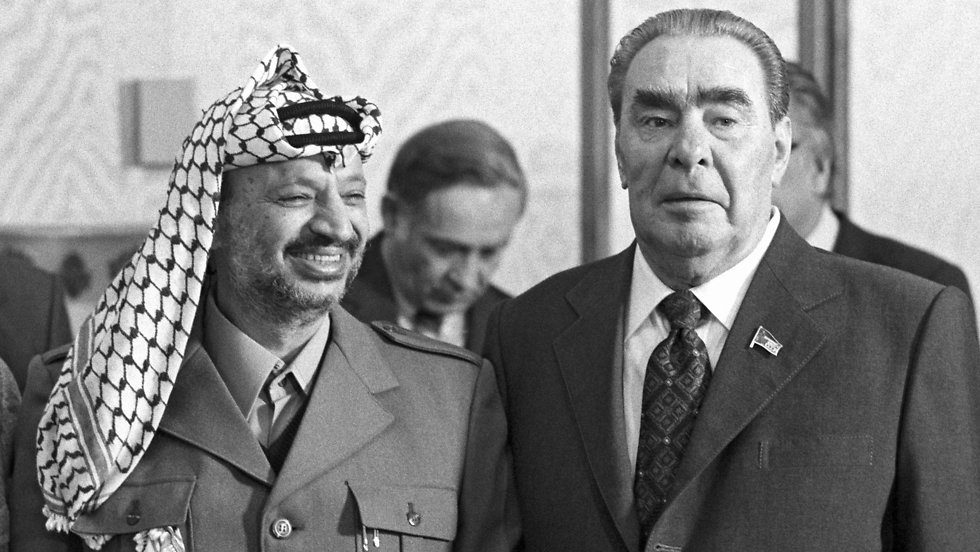
Secret KGB documents reveal just how deeply involved the Soviet Union was in the spilling of Israeli blood. The Russian spy agency provided Palestinian terror organizations with funds, training and arms, running agents like ‘Krotov’ – aka Mahmoud Abbas, ‘Aref’ – or Yasser Arafat, and ‘Nationalist,’ who was behind several plane hijackings long before 9/11.
Zuheir Mohsen, a senior PLO leader, in 1977, said : “The Palestinian people do not exist. The creation of a Palestinian state is only a means for continuing our struggle against the state of Israel for our Arab unity… Only for political and tactical reasons do we speak today about the existence of a Palestinian people, since Arab national interests demand that we posit the existence of a distinct ‘Palestinian people’ to oppose Zionism. Yes, the existence of a separate Palestinian identity exists only for tactical reasons.”
1969: Fatah took over the PLO. Arafat became Chairman. His keffiyeh, his olive-green uniform, his pistol on his hip—he crafted an image. "The revolution is our school," he declared. The world began to listen.
Part II: The Guerrilla Diplomat (1967–1993)
Chapter 4: Black September (1970)
Jordan. King Hussein turned on the PLO, fearing a coup. His army massacred thousands of Palestinians in Amman. Arafat escaped to Lebanon, but the myth of Black September haunted him. "We have no friends but the mountains," he said.
Chapter 5: Munich 1972
Olympic Village. Black September (a PLO splinter group) kidnapped and killed 11 Israeli athletes. The world condemned Arafat. But in the refugee camps, he was a hero. "Revolution is not a dinner party," he told his critics.
- Abu Daoud (1999): "Arafat was happy. He said, ‘This will make the world pay attention to us.’"
- Ali Hassan Salameh (to CIA): "The operation was necessary. Arafat understood the cost."
Chapter 6: The Lebanese Civil War (1975–1982)
Beirut. The PLO turned Lebanon into a state within a state. Arafat ruled from Fakhani, his headquarters a fortress. But Israel invaded in 1982. Siege of Beirut. For three months, the Israelis bombed the city. Arafat refused to surrender. Finally, exile. "We shall return!" he shouted as he boarded a ship to Tunis.
Chapter 7: The Tunis Years (1982–1993)
Exile. The PLO was scattered. Arafat was isolated. But he reinvented himself.
- 1988: Declared a Palestinian state in Algers.
- 1988: Recognized Israel (implicitly) at the UN.
- 1991: Lost Gulf War support after backing Saddam Hussein.
"We must be flexible," he told his lieutenants. The Cold War was ending. The Soviets were gone. Arafat needed a new strategy.
Part III: The Oslo Gambit (1993–2004)
Chapter 8: The Secret Talks
Norway. 1993. Arafat’s deputy, Mahmoud Abbas (Abu Mazen), met with Israeli officials in Oslo. Arafat gambled everything on a deal:
- Palestinian Authority in Gaza/Jericho.
- Limited self-rule in the West Bank.
- No state. No Jerusalem. No right of return.
"This is the best we can get," he told his critics.
September 13, 1993: The White House Lawn. Arafat, Rabin, Clinton. The handshake. "The peace of the brave," Clinton called it. The Palestinians called it betrayal.
Chapter 9: The President of Nothing
Gaza, 1994. Arafat returned a hero. But the Oslo Accords were a trap:
- Israel kept settlements.
- Hamas rose in opposition.
- Corruption festered in the PA.
"He’s building a dictatorship!" his rivals said. "He’s a traitor!" the Islamists screamed.
Chapter 10: The Second Intifada (2000–2004)
Camp David, 2000. Clinton, Barak, Arafat. "Take it or leave it," Barak said. Arafat walked out. "I cannot sign away Jerusalem," he told his people. The Intifada exploded.
- Suicide bombings.
- Israeli assassinations.
- Arafat, trapped in his Ramallah compound, starving, humiliated.
"They want to kill me," he rasped to his aides.
Chapter 11: The Poisoned Chalice
2004. Paris. Arafat was dying. The Israelis wouldn’t let him leave for treatment. The French took him in. November 11, 2004. "I am a martyr for Palestine," he whispered. Then he was gone.
Epilogue: The Legacy of a Ghost
Ramallah, 2025.
His tomb is a mausoleum, guarded by PA security.
- To his supporters: He was the father of the nation, the symbol of resistance.
- To his critics: He was a corrupt dictator who sold out for a fake state.
- To the Israelis: He was a terrorist who never really wanted peace.
But the keffiyeh still flies. The gun still fires. And the nightmare of Palestine lives on.