

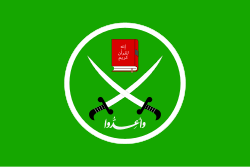
The Muslim Brotherhood (Arabic: al-Ikhwān al-Muslimūn) is a Sunni Islamist movement founded in Egypt in 1928 by Hassan al-Banna. Its goals have shifted over time depending on context, but its overarching aims can be summarized as follows:
Core Goals
Islamic Revival and Reform
- Promote a return to what it sees as true Islamic values in personal, social, and political life.
- Encourage Muslims to practice Islam not only as a religion but as a complete way of life (din wa dawla – religion and state).
Islamic Law (Sharia) as the Basis of Society
Gradually implement Islamic principles in governance, law, and social structures.
This does not always mean immediate imposition of strict rules, but rather a phased approach toward aligning state institutions with Islamic law.
Social and Educational Work
- Provide social services such as schools, hospitals, charities, and welfare programs, particularly where governments fail to meet needs.
- Use these networks to build grassroots support and strengthen Islamic identity.
Political Participation
Establish governance that reflects Islamic values, often framed as democratic but rooted in Islamic principles.
In Egypt and other countries, the Brotherhood has run candidates in elections and sought influence in parliaments.
Broader Vision
Long-term aspiration of fostering an Islamic state (and ideally, in classical rhetoric, unity of Muslim countries in a broader ummah).
Some factions emphasize gradual reform through peaceful means (education, social work, elections), while others historically endorsed resistance or militant methods in certain contexts.
Contemporary Shifts
In recent decades, the Brotherhood has often presented itself as a moderate Islamist movement supporting democratic processes, especially after the Arab Spring.
However, governments in Egypt, Saudi Arab, the UAE, and others have designated it as a terrorist or extremist organization, accusing it of plotting to undermine secular states.
In contrast, in some countries (e.g., Jordan, Morocco, Tunisia), Brotherhood-affiliated parties have been allowed to operate legally within politics.
The Muslim Brotherhood’s goal is to create a society and state governed by Islamic principles and law, achieved primarily through gradual social, educational, and political reform rather than sudden revolution—though its methods and image vary widely across countries.
The Muslim Brotherhood’s vision is rooted in the idea that Islam is a complete system for life and that Sharia (Islamic law) should be the foundation of society. But how far that goal extends depends on context:
1. Founding Ideology (1928 onward)
Hassan al-Banna and early Brotherhood thinkers spoke of restoring Islamic governance not only in Egypt but across the Muslim world.
They dreamed of reviving the unity of the ummah (the global Muslim community), which historically existed under the caliphate.
In theory, this implies a worldwide scope: promoting Islamic law and unity among Muslim-majority countries.
2. Practical Approach
In practice, the Brotherhood has focused on national politics first (e.g., Egypt, Jordan, Tunisia, Morocco), pushing for Sharia-based reforms locally.
They typically avoid calling for immediate global enforcement of Islamic law, instead prioritizing grassroots reform, elections, and social influence in their home countries.
Their idea is that if each Muslim-majority society becomes more Islamic, global unity may naturally follow.
3. Global Movement
The Brotherhood has inspired or built affiliates across the Muslim world (and even Muslim communities in Europe and North America).
Its writings emphasize solidarity across borders, but affiliates often adapt to local politics.
For example:
In Tunisia, the Ennahda party (Brotherhood-linked) accepts democracy and pluralism.
In Egypt, the Brotherhood pushed for Sharia clauses in the 2012 constitution.
4. Outside the Muslim World
The Brotherhood does not openly call for imposing Sharia worldwide on non-Muslims.
Instead, it focuses on empowering Muslim communities abroad to preserve Islamic identity, build mosques, and establish social organizations.
✅ So to answer directly:
The Muslim Brotherhood ideologically envisions Sharia as the ultimate foundation for Muslim societies everywhere, but its political efforts are mostly national rather than a global enforcement project. It does not explicitly promote imposing Islamic law on the whole world, but it does promote the spread of Islamic governance wherever Muslims live, with a long-term ideal of broader Muslim unity.
Would you like me to compare this vision with groups like ISIS or Hizb ut-Tahrir, which take a more explicitly global and immediate approach to Sharia?