

The Abraham Accords are a series of diplomatic agreements signed in 2020, brokered by the United States, between Israel and several Arab countries — initially the United Arab Emirates and Bahrain, later joined by Sudan and Morocco — with the goal of normalizing relations.
The name refers to the biblical patriarch Abraham, a figure central to Judaism, Christianity, and Islam, symbolizing a shared heritage among the peoples involved.
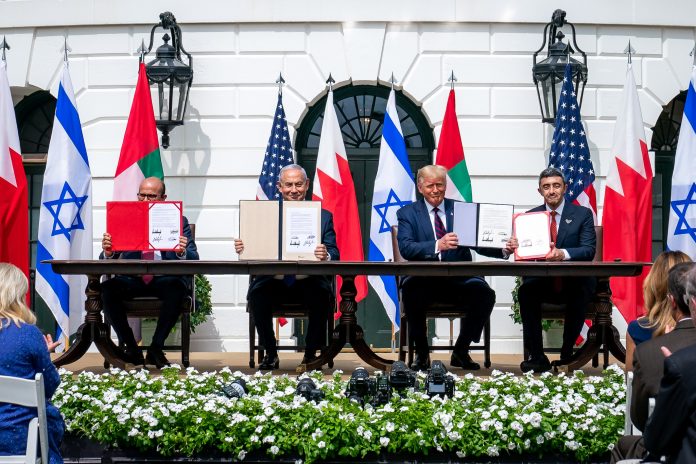
The accords are significant because, before them, most Arab countries conditioned any normalization with Israel on a resolution of the Israeli–Palestinian conflict. The Abraham Accords partly broke with that approach by prioritizing economic, technological, and security cooperation as a starting point.
In short:
- Goal: Establish official diplomatic ties and expand cooperation in various fields.
- Initial signatories (2020): Israel, United Arab Emirates, Bahrain (later joined by Sudan and Morocco).
- Main mediator: The United States (Trump administration).
- Impact: Seen as a historic breakthrough, but criticized by some — especially Palestinians — who view it as weakening traditional Arab support for their cause.
Timeline
- August 13, 2020 – Israel & United Arab Emirates announce a U.S.-brokered agreement to normalize relations.
- September 11, 2020 – Bahrain joins the agreement, making it the second Gulf country in a month to normalize ties with Israel.
- September 15, 2020 – Official signing ceremony at the White House (U.S. President Donald Trump hosts Israeli PM Benjamin Netanyahu, UAE Foreign Minister Abdullah bin Zayed, and Bahraini Foreign Minister Abdullatif Al Zayani).
- October 23, 2020 – Sudan agrees to normalize relations with Israel, in exchange for removal from the U.S. list of state sponsors of terrorism.
- December 10, 2020 – Morocco joins the accords; in return, the U.S. recognizes Moroccan sovereignty over Western Sahara.
- 2021–2023 – Growing cooperation between signatories in trade, tourism, technology, and defense; mixed reactions in the wider Arab world.
- 2023–2024 – Efforts to expand the accords to other Arab and Muslim-majority states, though regional tensions slow progress.