

In 1947, the United Nations proposed a Partition Plan (UN Resolution 181) to divide British Mandate Palestine into two states—one Jewish and one Arab, with Jerusalem placed under international administration.
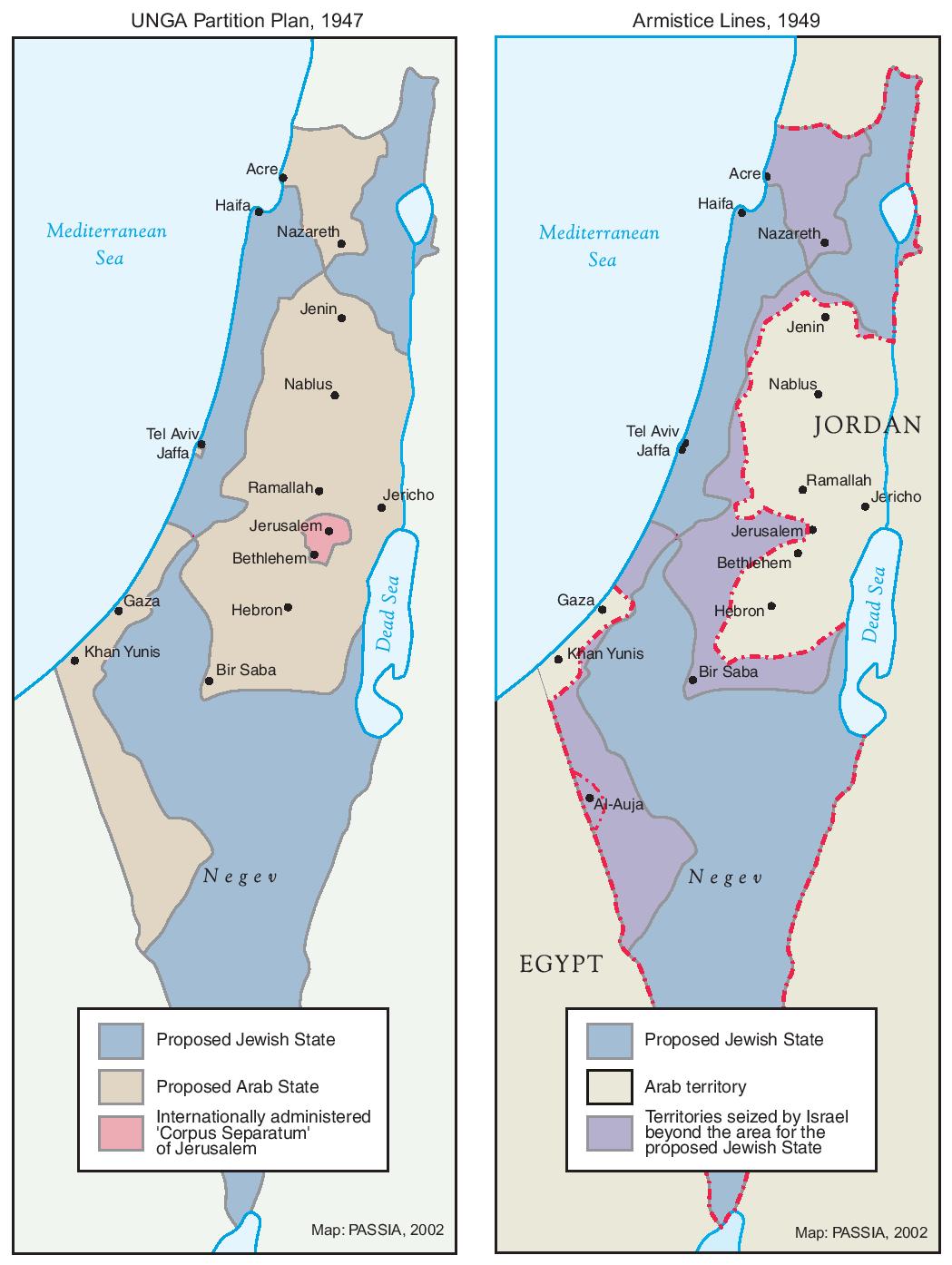
Here are the main points:
- Jewish state allocation: about 55% of the land.
- Arab state allocation: about 45% of the land.
Jerusalem & Bethlehem: designated as a separate international zone, not under either state.
| Aspect | Jewish State (55%) | Arab State (45%) |
|---|---|---|
| Arable Land | ~40% of the Jewish state’s territory was desert (Negev), while the rest included fertile coastal plains (e.g., Sharon Valley) and parts of Galilee. | ~80% of the Arab state’s land was fertile, including the West Bank’s highlands (rich in olive groves, citrus, and grains) and the Gaza Strip’s agricultural lands. |
| Water Resources | Controlled most of the coastal aquifers and the Jordan River’s upper basin (critical for irrigation). | Had access to underground aquifers in the West Bank but less control over major rivers. |
| Urban Centers | Included Tel Aviv, Haifa (major ports), and parts of Galilee (mixed Arab-Jewish population). | Included Jaffa (a key citrus-exporting port), Nablus, Jenin, and Hebron (historical trade hubs), but lost Haifa and Tel Aviv. |
| Population | 55% of land for ~600,000 Jews (many recent immigrants). | 45% of land for ~1.2 million Palestinian Arabs (long-established farming communities). |
| Strategic Areas | Gained Galilee’s security buffer and Negev’s potential for expansion. | Lost Jaffa’s port (economic lifeline) and western Galilee’s fertile soil to the Jewish state. |
Controversies Over "Best Lands"
- Arab Perspective: The plan gave the Jewish state most of the coastal plains (where citrus industries thrived) and Galilee’s mixed-arable land, while the Arab state was left with hilly, less-developed areas (though still fertile).
- Jewish Perspective: The Negev (60% of the Jewish state’s land) was barren desert, requiring massive investment to become productive. The Jewish state also had fewer natural resources at the time.
- Jerusalem: Neither side got it—it was meant to be an international city, which both Jews and Arabs rejected.
What happened next:
- Jewish leaders accepted the plan (though reluctantly).
- Arab leaders rejected it, seeing it as illegitimate, and neighboring Arab states declared war when Israel declared independence in May 1948.
The war that followed (the 1948 Arab–Israeli War, or Nakba for Palestinians) resulted in Israel expanding its territory to about 78% of the former mandate, while Jordan took control of the West Bank and Egypt controlled Gaza. Hundreds of thousands of Palestinians became refugees.