

The story of the Ottoman Empire is one of the most fascinating in world history—it spans over 600 years, from a small frontier principality to a vast empire that shaped Europe, Asia, and Africa. Here’s a clear timeline-style narrative:
Origins (13th–14th Century)
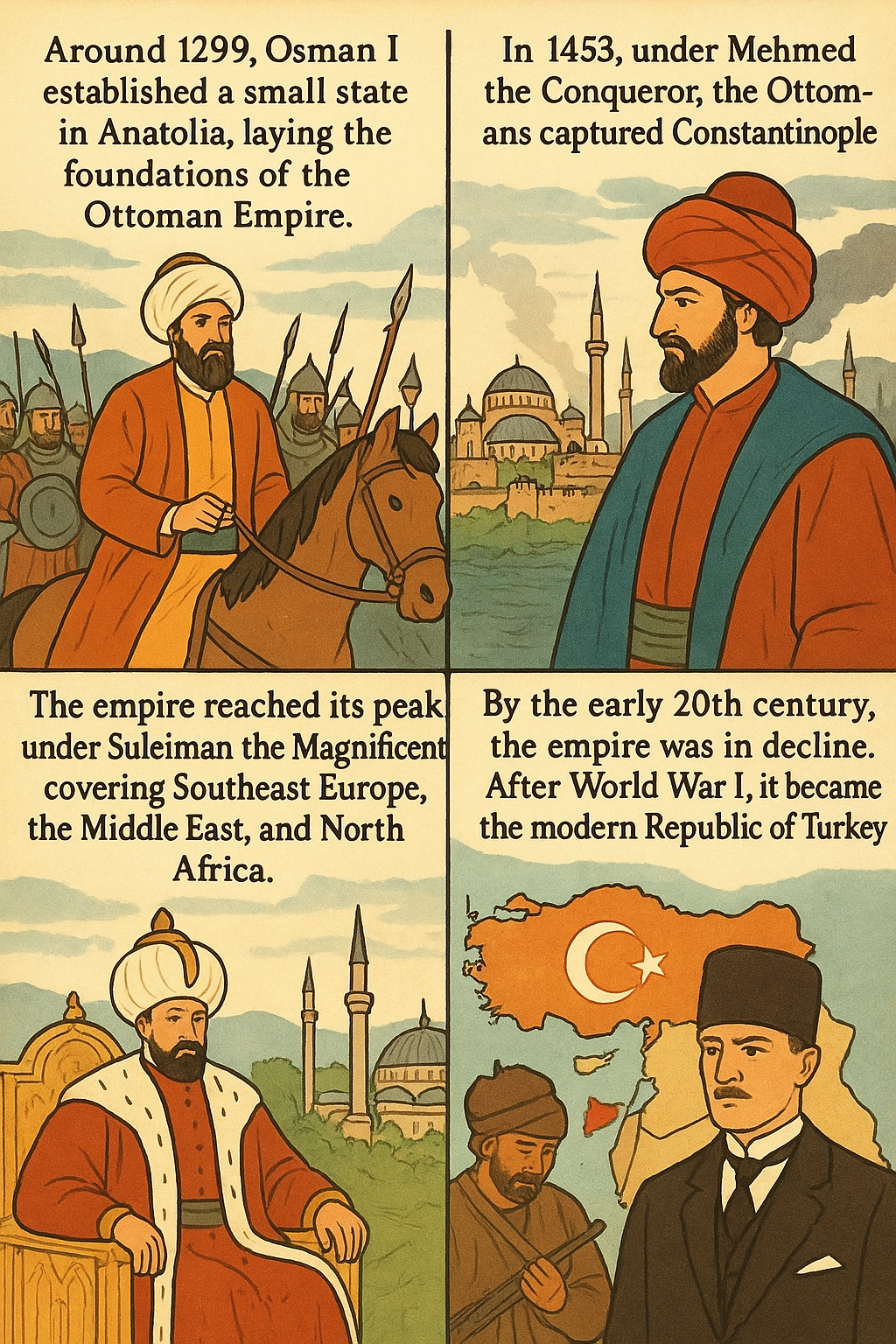
Around 1299, Osman I, a Turkish tribal leader in Anatolia (modern-day Turkey), established a small state on the frontier of the Byzantine Empire. His followers were later called Ottomans (after Osman).
The Ottomans were skilled warriors and took advantage of the weakening Byzantines and rival Turkish states.
Expansion and Rise (14th–15th Century)
By the mid-1300s, they had crossed into Europe (the Balkans).
In 1453, Mehmed II (“the Conqueror”) captured Constantinople (modern-day Istanbul), ending the Byzantine Empire. The city became the Ottoman capital and a hub of trade, culture, and Islam.
Golden Age (16th–17th Century)
The empire reached its peak under Suleiman the Magnificent (1520–1566).
At its height, it stretched across:
- Southeast Europe (the Balkans, Hungary, Greece)
- The Middle East (Iraq, Syria, Arabia, Egypt)
- North Africa (Algeria, Libya, Egypt)
The Ottomans controlled trade routes between Europe and Asia and commanded a powerful navy in the Mediterranean.
The empire was a center of art, architecture (like the Süleymaniye Mosque), law, and science.
Challenges and Decline (17th–19th Century)
After Suleiman, the empire began to weaken:
- Military defeats (like the Battle of Vienna, 1683) slowed expansion.
- European powers (especially Austria, Russia, and later Britain and France) grew stronger.
- Economic problems appeared as trade shifted to the Atlantic after European exploration of the Americas.
- The empire was often called the “Sick Man of Europe” by the 19th century.
- Nationalist revolts (Greeks, Serbs, Arabs, Armenians, etc.) chipped away at its territory.
Fall (20th Century)
During World War I (1914–1918), the Ottomans sided with Germany and Austria-Hungary.
They were defeated, and the empire collapsed.
In 1923, Mustafa Kemal Atatürk abolished the Ottoman Sultanate and founded the modern Republic of Turkey.
Legacy
The Ottoman Empire lasted over 600 years (1299–1922).
It shaped the history, culture, architecture, cuisine, and politics of three continents.
Land once ruled by the Ottomans is now home to more than 30 modern countries.