

The United Nations Resolution 181 (II), officially titled the Partition Plan for Palestine, was adopted by the United Nations General Assembly on November 29, 1947, during its second session. This resolution emerged in the context of the end of the British Mandate for Palestine, which had been established by the League of Nations after World War I.
By the mid-1940s, the British government, facing growing violence between Jewish and Arab communities in Palestine and increasing international pressure, referred the issue to the United Nations. The UN responded by creating the United Nations Special Committee on Palestine (UNSCOP) in May 1947. After extensive investigations, UNSCOP proposed a plan to partition Palestine into two independent states—one Jewish and one Arab—with Jerusalem placed under international administration as a corpus separatum (a separate entity).
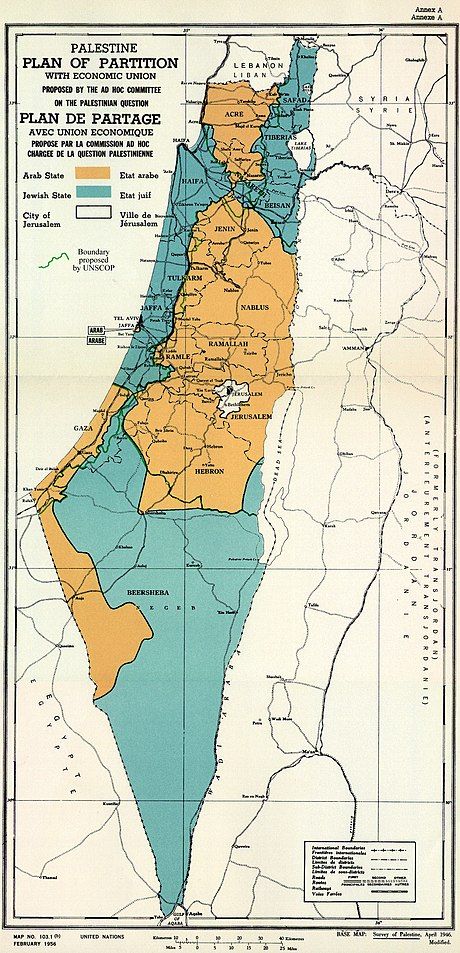
The resolution was the result of intense diplomatic negotiations and lobbying. The United States and the Soviet Union, despite their Cold War tensions, both supported the partition plan, which helped secure the necessary two-thirds majority in the General Assembly. The vote took place on November 29, 1947, and the resolution was adopted with 33 countries voting in favor, 13 against, and 10 abstaining. Notably, Britain, which held the Mandate for Palestine, abstained from voting, reflecting its desire to distance itself from the increasingly volatile situation.
The plan allocated approximately 55% of the land to the Jewish state and 45% to the Arab state, even though the Jewish population at the time was about 30% of the total and owned less than 7% of the land. The proposed Jewish state included areas with a significant Arab population, while the Arab state included areas with a Jewish minority. Jerusalem, a city of immense religious and cultural significance to both Jews and Arabs, was to be placed under international control, administered by the United Nations, to avoid conflict over its status.
The Jewish Agency for Palestine, representing the Jewish community, accepted the resolution as a legal basis for the establishment of a Jewish state, despite reservations about the borders and the inclusion of many Arabs within the proposed Jewish state. In contrast, the Arab Higher Committee, representing the Palestinian Arab community, and the surrounding Arab states vehemently rejected the resolution. They argued that the partition plan violated the principle of self-determination, as it imposed a solution without the consent of the majority Arab population. They also viewed the territorial allocation as unfair, given the demographic and land ownership realities at the time.
The adoption of Resolution 181 marked a turning point in the history of the region. Almost immediately after the vote, violence erupted between Jewish and Arab communities in Palestine. The British Mandate officially ended on May 14, 1948, and the following day, the State of Israel declared its independence. This was swiftly followed by the 1948 Arab-Israeli War, as neighboring Arab states invaded Palestine in an attempt to prevent the establishment of the Jewish state. The war resulted in a significant shift in borders, with Israel expanding beyond the boundaries proposed in Resolution 181, and the proposed Arab state failing to materialize. The city of Jerusalem was divided between Israeli and Jordanian control, and hundreds of thousands of Palestinians were displaced in what they refer to as the Nakba (catastrophe).
In the decades that followed, Resolution 181 became a symbolic reference point in the Israeli-Palestinian conflict. For Israelis, it provided international legitimacy for the creation of their state. For Palestinians, it is often cited as evidence of the international community’s recognition of their right to statehood, even though the resolution’s implementation was derailed by war. The resolution has been invoked in subsequent UN resolutions and legal opinions, including the 1988 Palestinian Declaration of Independence, which explicitly referenced Resolution 181 as a basis for Palestinian statehood.
The legacy of Resolution 181 continues to resonate in contemporary discussions about peace and statehood in the region. It remains a contentious and central document in the history of the Israeli-Palestinian conflict, illustrating both the complexities of international diplomacy and the enduring challenges of reconciling competing national narratives.