

“Dar” classifications in Islamic jurisprudence—the way scholars divide the world based on Islamic law and governance. This is often called the “Dar al-Islam / Dar al-Harb” system.” Here’s a careful breakdown:
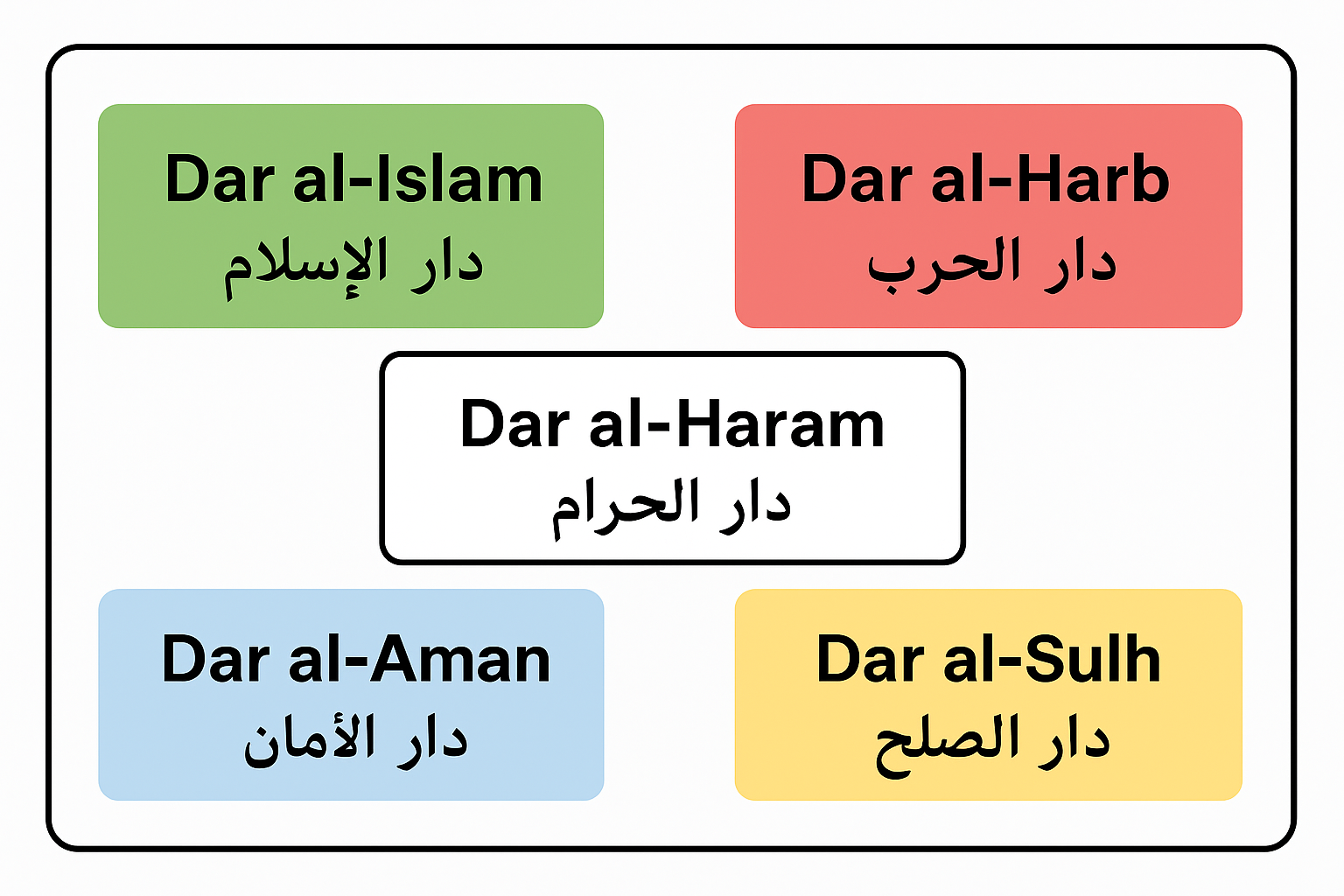
Dar al-Islam (دار الإسلام) – “House of Islam”
Lands where Islamic law (Sharia) is established and Muslims can practice their faith freely.
Examples: historically, the core Islamic states, like the early Caliphates.
Modern interpretation: most Muslim-majority countries.
Dar al-Harb (دار الحرب) – “House of War”
Lands not under Islamic rule where Muslims cannot freely practice their religion or where Islamic law isn’t applied.
War is the inly project for these Dars which have to be conquered
Historically, this term was used for territories hostile to Islamic states.
Dar al-Aman (دار الأمان) – “House of Safety / Peace”
Territories that are non-Muslim but where Muslims are guaranteed safety and religious freedom.
Often considered a subset or neutral territory compared to Dar al-Harb.
Dar al-Sulh (دار الصلح) – “House of Treaty / Accord”
Lands that have a treaty with a Muslim state, guaranteeing peace and security.
Sometimes overlaps with Dar al-Aman.
Dar al-Haram (دار الحرام) – “Sacred House / Sanctuary”
These are holy sanctuaries like Mecca and Medina.
Within this area, certain prohibitions apply, like restrictions on fighting or harming others.