
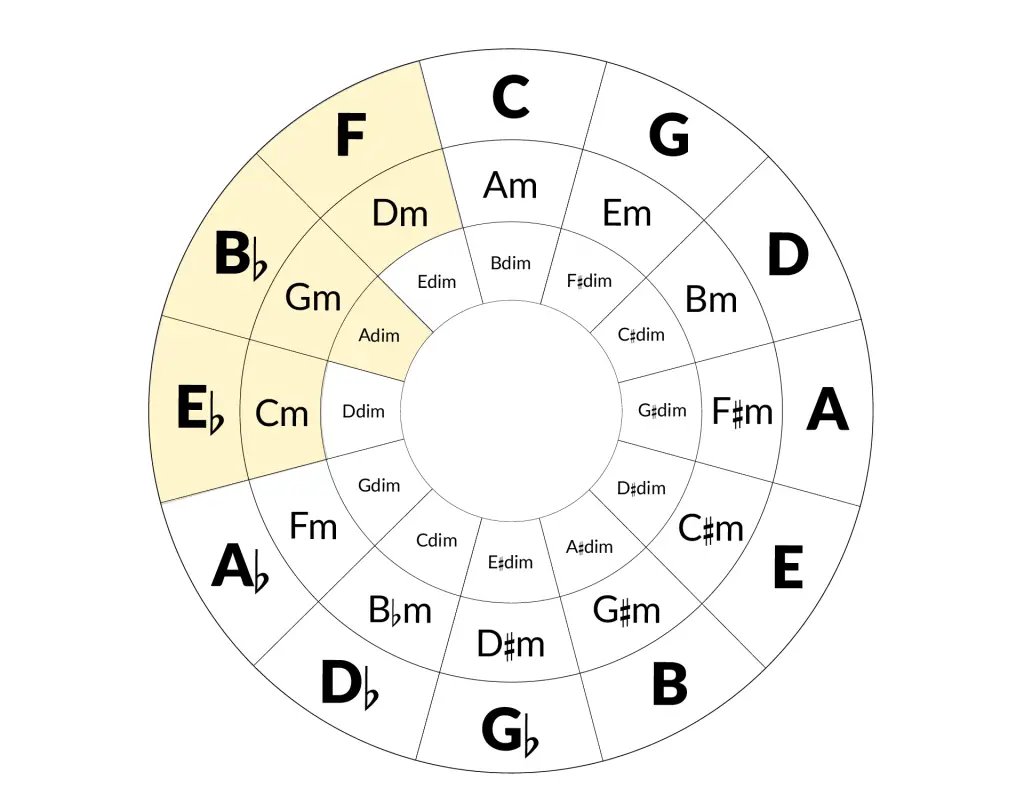
The Circle of Fifths is a visual representation of the relationships among the 12 tones of the chromatic scale, their corresponding key signatures, and their relative major and minor keys. It’s a useful tool for musicians to understand key relationships, chord progressions, and modulation.
How It Works:
Fifths Progression: Starting from C major (at the top of the circle), each step clockwise moves up by a perfect fifth:
- C → G → D → A → E → B → F♯ (or G♭) → D♭ → A♭ → E♭ → B♭ → F → (back to C)
Key Signatures:
- Moving clockwise, each key adds one sharp.
- Moving counterclockwise, each key adds one flat.
Minor Keys: Each major key has a relative minor, which shares the same key signature. The relative minor is located a minor third down from the major key.
- C major (no sharps or flats) → A minor (no sharps or flats)
- G major (1 sharp) → E minor (1 sharp)
- D major (2 sharps) → B minor (2 sharps), etc.
Enharmonic Equivalents: Some keys have two names:
- F♯ major (6 sharps) is the same as G♭ major (6 flats).
- D♭ major = C♯ major, etc.
Uses of the Circle of Fifths:
- Key Modulation: Helps in transitioning smoothly between related keys.
- Chord Progressions: Common progressions like ii-V-I and I-IV-V follow circle of fifths movement.
- Composing & Improvisation: Identifies which chords fit together in a key.
- Understanding Harmony: Shows closely related keys and their relationships.