

The Land of Time: Jordan’s Ancient Roots
Jordan is a palimpsest of history, its layers written in stone and sand. Long before the rise of empires, the land was home to hunter-gatherers and early farmers. By 3000 BCE, the fertile valleys and highlands nurtured some of the world’s first settled communities.
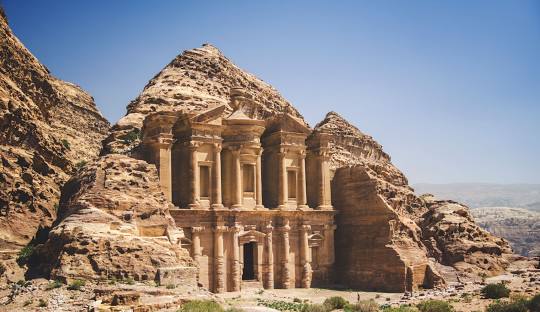
Petra, the rose-red city half as old as time, was carved from living rock by the Nabataeans—a nomadic people who mastered the art of water management and trade. Their kingdom, centered in Petra, became a crossroads for caravans laden with frankincense, myrrh, and spices, linking Arabia to the Mediterranean. The sight of Petra’s Treasury, glowing in the morning light, is said to have inspired poets and explorers for centuries.
To the north, the Greco-Roman city of Jerash stands as a testament to Jordan’s place in the classical world. Its colonnaded streets, theaters, and temples rival those of Rome itself, a reminder that this land was once a jewel of the Roman East.
The Tide of Empires: From Islam to the Ottomans
With the dawn of Islam in the 7th century, Jordan became a sacred land. It was here, near the Jordan River, that the Prophet Moses is said to have gazed upon the Promised Land, and where Jesus was baptized. The Umayyad caliphs, ruling from Damascus, built desert palaces like Qasr Amra, their mosaics and frescoes depicting scenes of royal life and hunting.
For centuries, Jordan was a battleground and a bridge. The Crusaders built castles like Karak and Shobak, their stone walls still standing sentinel over the valleys. Saladin, the Kurdish warrior who reclaimed Jerusalem, passed through these lands, his name still spoken with reverence.
Under the Ottomans, Jordan was a quiet province, its people living as they had for generations—herding goats, farming olives, and trading across the desert. But the winds of change were coming.
The Birth of a Nation: From Mandate to Kingdom
The collapse of the Ottoman Empire after World War I brought new masters. The British and French drew lines on maps, and Jordan—then called Transjordan—became a British mandate. But the spirit of independence was strong. In 1946, under the leadership of King Abdullah I, Jordan became a sovereign kingdom.
The new nation was immediately tested. The 1948 Arab-Israeli war brought waves of Palestinian refugees, transforming Jordan’s demographics and society. King Hussein, who ruled for nearly half a century, steered the country through wars, coups, and the Cold War, earning a reputation as a wise and pragmatic leader.
In 1994, Jordan made history again by signing a peace treaty with Israel, a bold move that cemented its role as a mediator in the region.
Jordan Today: A Beacon of Stability
Modern Jordan is a country of contrasts. Its capital, Amman, is a bustling metropolis of white stone and ancient citadels, where minarets and church bells ring out over the city. The Dead Sea, the lowest point on Earth, draws visitors to its mineral-rich waters, while the deserts of Wadi Rum—“the Valley of the Moon”—inspire awe with their martian landscapes.
Yet Jordan faces challenges. Water is scarce, the economy is strained, and the country has absorbed hundreds of thousands of refugees from Iraq, Syria, and beyond. But Jordanians are resilient, their culture a tapestry of Bedouin tradition, Arab heritage, and modern ambition.
The Soul of Jordan
To walk through Jordan is to walk through time. The Bedouin still tell stories by the fire, their voices carrying across the desert. The scent of za’atar and fresh bread fills the air in the old souks. And in the quiet of the desert, under a sky ablaze with stars, you can almost hear the footsteps of the Nabataeans, the Crusaders, and the prophets who once walked this land.
Jordan is more than a country—it is a living museum, a crossroads of civilizations, and a testament to the enduring spirit of its people.
Would you like to explore a particular era, place, or legend in more depth? Or perhaps the stories of its kings, its poets, or its everyday heroes?
King Abdullah I
of Jordan was a figure of immense historical significance—a warrior, a diplomat, and the founder of modern Jordan. His life spanned the twilight of the Ottoman Empire, the tumult of World War I, and the birth of a new nation in the heart of the Middle East.
The Sharifian Prince: Early Life and Lineage
Born in Mecca in 1882, Abdullah was the second son of Hussein bin Ali, the Sharif and Emir of Mecca, and a direct descendant of the Prophet Muhammad. His family, the Hashemites, were the traditional guardians of Islam’s holiest cities. Abdullah was educated in Istanbul, the Ottoman capital, where he learned the arts of statecraft and war.
The Great Arab Revolt: A Leader is Forged
During World War I, Abdullah and his brothers—Faisal, Ali, and Zeid—played pivotal roles in the Great Arab Revolt against Ottoman rule. Allied with the British, including the legendary T.E. Lawrence (Lawrence of Arabia), Abdullah led Bedouin forces in guerrilla campaigns, most famously at the Battle of Aqaba. His leadership and strategic brilliance earned him respect among both Arab tribes and European powers.
The Making of Transjordan
After the war, the Middle East was carved up by the victorious Allies. Abdullah’s brother Faisal became king of Iraq, while Abdullah himself was initially offered the throne of Iraq but declined. Instead, he set his sights on the lands east of the Jordan River.
In 1921, with British support, Abdullah became the Emir of Transjordan, a semi-autonomous territory under the British Mandate. He ruled with a mix of pragmatism and vision, consolidating power among the Bedouin tribes and laying the foundations for a modern state.
Independence and the Birth of Jordan
Abdullah’s greatest achievement came in 1946, when Transjordan gained full independence from Britain. He declared himself King Abdullah I of the Hashemite Kingdom of Transjordan, later renamed the Hashemite Kingdom of Jordan in 1949.
His reign was marked by a delicate balancing act: maintaining independence, managing relations with Britain, and navigating the complex politics of the Arab world. He was a staunch advocate for Arab unity but also a realist, willing to engage with the West and even Israel when necessary.
The 1948 War and the Assassination
Abdullah’s final years were dominated by the 1948 Arab-Israeli War. Jordan’s army, the Arab Legion, was the most effective Arab force in the conflict. Abdullah secretly negotiated with Israel, leading to a controversial peace agreement that expanded Jordan’s territory to include the West Bank and East Jerusalem.
This move, seen by many Arabs as a betrayal, made him enemies. On July 20, 1951, while attending Friday prayers in Jerusalem, Abdullah was assassinated by a Palestinian gunman, a tragic end to a life dedicated to Arab leadership and state-building.
Legacy: The Father of Modern Jordan
King Abdullah I is remembered as the founder of modern Jordan. His leadership transformed a collection of tribes and desert lands into a stable, sovereign nation. His descendants—King Hussein and King Abdullah II—have continued his legacy, guiding Jordan through decades of regional upheaval.
Abdullah’s vision of a moderate, pro-Western Arab state endures, as does his reputation as a man of both action and intellect, a bridge between tradition and modernity.
Would you like to know more about his personal life, his political philosophy, or the impact of his assassination on the region?